OPTICAL IMAGING AND ELECTROPHYSIOLOGICAL RECORDING IN NEUROSCIENCE
A 13-day residential course of lectures, demonstrations and practical work; a lectures-only option will be available online
LECTURES AND PRACTICALS
Lectures and practicals held at the Campus Saint Germain of the UPCité, 45 Rue des Saints Peres, 75006 Paris, France. Three days of demonstrations and lab visits are run at the Ecole Normale Supérieure (IBENS), Paris brian Institute (ICM) and Vision Institute (IdV). World-expert lecturers and instructors come from Paris, France, Europe, the world.
FEES
The course fee is expected to be around 2000€/1500€ per student with/without accommodation (depending on funding). Special arrangements exist for attending lectures only (including online for a modest fee). We can sometimes offer a stipend, which we typically reserve for participants from a low or middle-income country.
HANDS-ON
The course consolidates basic knowledge of electronics and optics with practicals follower by all students. We then offer intensive hands-on experimental sessions over six days, with dedicated instructors and setups assembled with the latest equipment. Students choose 3 state of the art techniques over the 9 to 11 avilable.
BOARD AND LODGING
Basic accomodation in a student residence should be available. Breakfast and lunch will be provided at the course (except Sundays). All students and lecturers are invited to the welcome and farewell banquets.
DEMONSTRATIONS
There are numerous demonstrations of advanced techniques, including: high-speed two-photon imaging, in vitro and in vivo light-sheet imaging, wavefront engineering,.
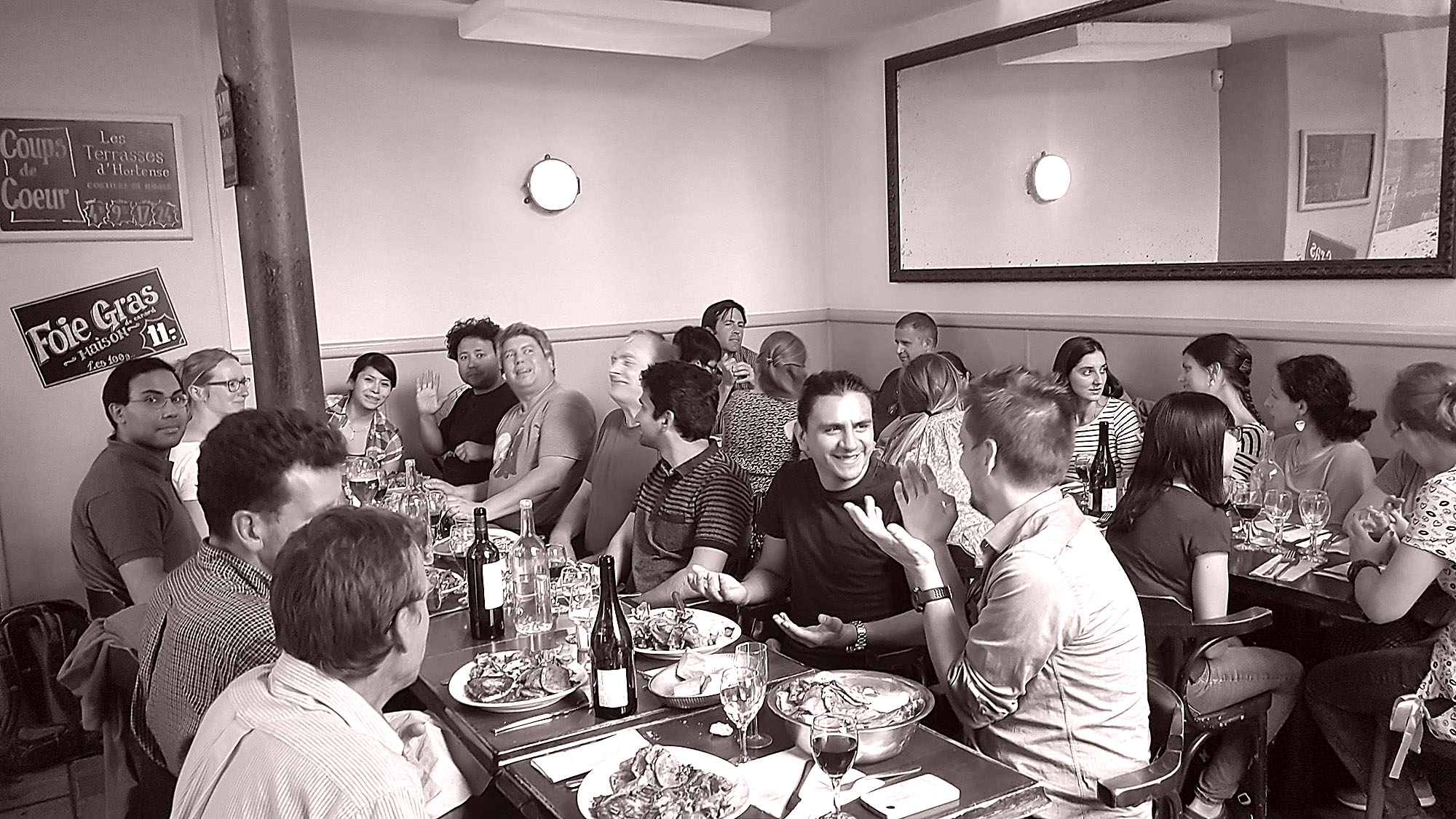
PARISIAN RESEARCH SOCIAL
TESTIMONIALS
All the feedback from the 2025 class
This course helped me really understand all the basics I needed for a solid foundation to build on during my PhD. The lectures were very thorough and were complemented well by the hands-on practicals as well as the laboratory visits and demonstrations. It was refreshing to get to spend these 3 weeks alongside other early-career neuroscientists, learning from experts who are passionate about passing on their knowledge to the next generation. Thank you!
It was an incredibly intense and rewarding two weeks from a scientific perspective. I gained new techniques and had the privilege of conversing with experienced scientists who generously shared their advice and answered numerous questions I had.
As a PhD student, I would suggest this course to anyone who would be interested in learning several techniques from professionals themselves. It was a great social and scientific experience which more than making you learn about the methods, it makes you understand them enough to use them in our projects, bringing them to our labs and maybe even our own future teams! A must for every aspiring researcher and a privilege to come into contact with excellence at the level of scientific discussion, institutes and researchers. It certainly ignited my spirit as a neuroscientist and despite being really intense, brought me a great motivation to go on with my career in academia.
Founder and principal Organizer for the first 10 editions:
David Ogden
Organizers
Boris Barbour
IBENS
Brandon Stell
Université Paris Cité
Jon Bradley
ENS
Desdemona Fricker
Université Paris Cité
Joana LOURENCO
ICM
Michael Graupner
Université Paris Cité
Nelson Rebola
ICM
Eric Schwartz
Université Paris Cité
Cathie Ventalon
IBENS
Adrien Schramm
Course manager
Staff
Gilles Dewailly
Université Paris Cité
Luc Tamisier
Université Paris Cité
Hervé Suaudeau
Université Paris Cité